Currently Empty: $0.00
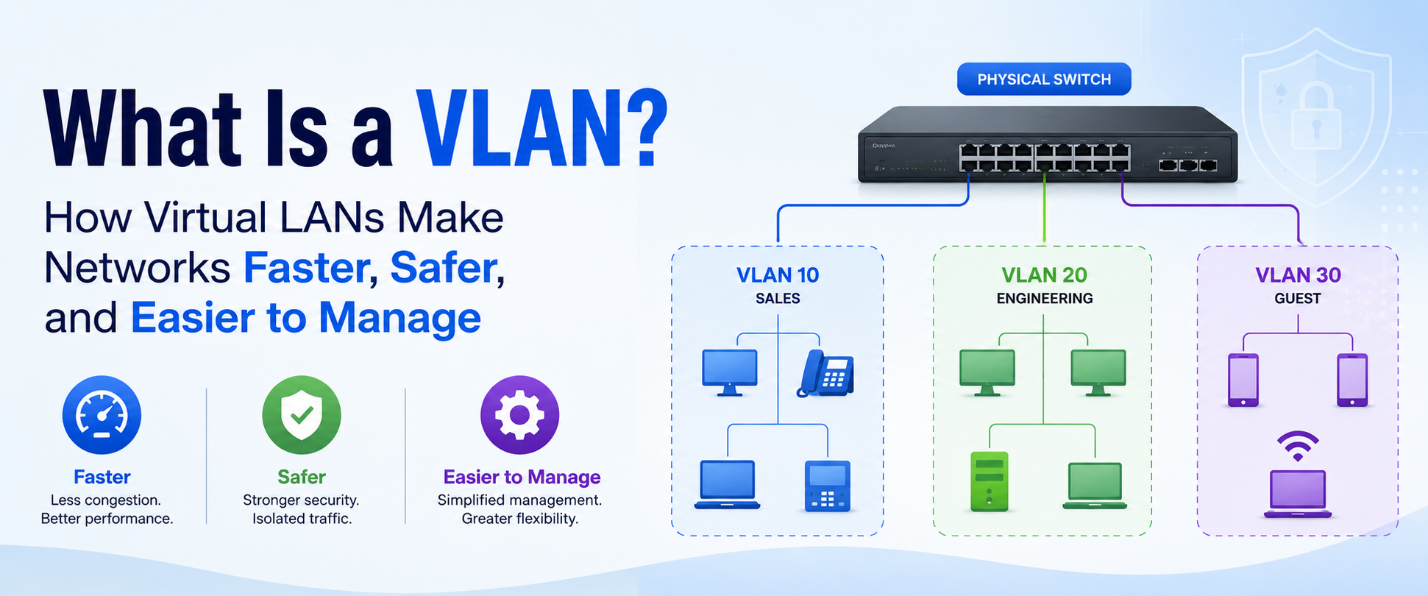
What Is a VLAN? How Virtual LANs Make Networks Faster, Safer, and Easier to Manage
certbits
- July 6, 2026
- 0 Comments
Imagine working in an office where every employee, printer, server, and Wi-Fi device is connected to the same network without any separation. Every broadcast reaches every device, traffic becomes congested, and sensitive company data can easily be exposed to unauthorized users.
Now imagine dividing that single network into multiple secure, organized networks without adding extra switches or cables.
That’s exactly what a Virtual Local Area Network (VLAN) does.
Whether you’re preparing for CCNA, CCNP, CCIE, or simply learning networking, understanding VLANs is one of the most important concepts you’ll encounter. In this guide, we’ll explore what VLANs are, how they work, why businesses use them, and how they improve network performance and security.
What Is a VLAN?
A Virtual Local Area Network (VLAN) is a logical way of dividing a physical network into multiple separate networks.
Instead of grouping devices based on where they’re plugged in, VLANs group devices based on their function, department, or security requirements.
For example, a company can create separate VLANs for:
Human Resources
Finance
Sales
IT Department
Guest Wi-Fi
Security Cameras
Voice (IP Phones)
Although all devices may be connected t
Why Do We Need VLANs?
Imagine a company with 300 employees connected to one large network.
Problems quickly arise:
Too much broadcast traffic
Poor network performance
Difficult troubleshooting
Limited security
No separation between departments
VLANs solve these problems by creating smaller, isolated broadcast domains.
Each department communicates within its own VLAN, reducing unnecessary traffic and improving overall efficiency.
Benefits of VLANs
. Improved Security
2. Better Performance
3. Easier Network Management
Reduced Broadcast Domains
Scalability
Types of VLANs
Default VLAN
Data VLAN
Voice VLAN
Management VLAN
Native VLAN
What Is Inter-VLAN Routing?
Since VLANs are separate networks, devices in different VLANs cannot communicate directly.
For example:
Finance (VLAN 10)
Sales (VLAN 30)
If Finance needs access to a shared server in Sales, a Layer 3 device must route traffic between the VLANs.
This process is known as Inter-VLAN Routing.
It can be achieved using:
A router (Router-on-a-Stick)
A Layer 3 switch (the preferred method in modern networks)
VLANs are one of the most powerful technologies in modern networking. By allowing administrators to logically divide a physical network into smaller, secure, and efficient segments, VLANs improve performance, simplify management, and strengthen security. Whether you’re setting up a small office network or designing infrastructure for a global enterprise, VLANs provide the flexibility and control needed to build scalable and reliable networks. Mastering VLANs is not only essential for Cisco certification exams but also a valuable skill for any aspiring network engineer.