Currently Empty: $0.00
TCP/IP vs OSI Model: Understanding the Two Pillars of Computer Networking
certbits
- June 27, 2026
- 0 Comments
In the world of networking, two models are discussed more than any others—the OSI (Open Systems Interconnection) Model and the TCP/IP (Transmission Control Protocol/Internet Protocol) Model. Whether you’re preparing for CCNA, CCNP, CCIE, Network+, or any networking certification, understanding these models is essential.
Many beginners wonder:
“If TCP/IP is used in real-world networks, why do we still learn the OSI Model?”
The answer is simple: OSI helps you understand networking, while TCP/IP makes networking work.
Let’s dive deep into both models and understand their differences, similarities, and practical importance.
What is the OSI Model?
The OSI Model is a 7-layer conceptual framework developed by the International Organization for Standardization (ISO) to standardize network communication.
It explains how data travels from one device to another, layer by layer.
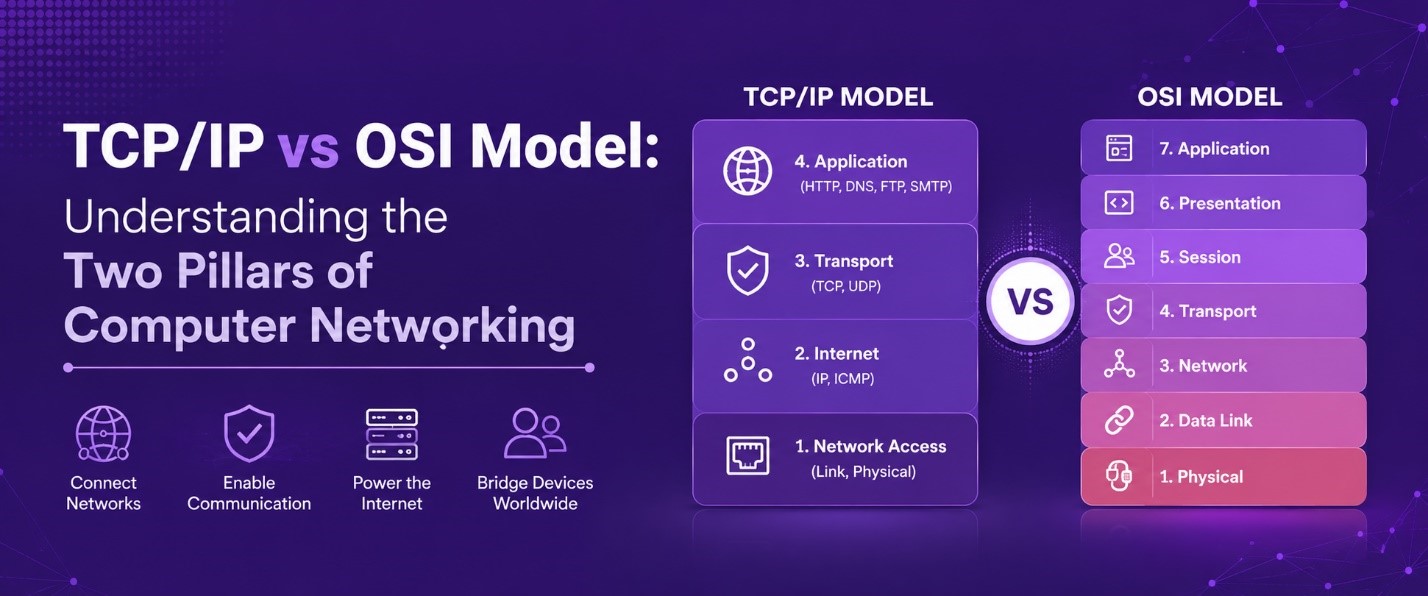
The 7 Layers of OSI
| Layer | Name | Function |
| 7 | Application | User interaction, applications |
| 6 | Presentation | Encryption, compression, translation |
| 5 | Session | Establishes and manages sessions |
| 4 | Transport | Reliable delivery, segmentation |
| 3 | Network | Routing and logical addressing |
| 2 | Data Link | MAC addressing, switching |
| 1 | Physical | Cables, signals, hardware |
What is the TCP/IP Model?
The TCP/IP Model is the practical networking model used by the Internet and almost every modern network.
Developed by the U.S. Department of Defense, it defines how devices communicate across interconnected networks.
Unlike OSI, TCP/IP is based on real protocols, not just theory.
The 4 Layers of TCP/IP
| Layer | Responsibilities |
| Application | Network applications and services |
| Transport | End-to-end communication (TCP/UDP) |
| Internet | IP addressing and routing |
| Network Access | Physical transmission and MAC addressing |
Major Differences Between TCP/IP and OSI
| Feature | OSI Model | TCP/IP Model |
| Number of Layers | 7 | 4 |
| Developed By | ISO | DoD (Department of Defense) |
| Nature | Conceptual Model | Protocol Suite |
| Real-world Usage | Educational | Internet Standard |
| Flexibility | Highly structured | Practical and flexible |
| Protocol Independent | Yes | No (built around TCP/IP protocols) |
Which Model Should You Focus On?
The answer is both.
Learn the OSI Model if you want to:
Understand networking fundamentals
Troubleshoot efficiently | Pass networking interviews | Prepare for certification exams
Learn TCP/IP if you want to:
Configure real networks | Understand Internet communication | Work with routers and switches | Build cloud and enterprise networks
Together, these models provide both the theoretical knowledge and practical skills needed by networking professionals.
The debate between TCP/IP and OSI isn’t about choosing one over the other they complement each other.
The OSI Model provides a structured framework for understanding how network communication works and for troubleshooting issues systematically. The TCP/IP Model is the practical protocol suite that powers the Internet and modern enterprise networks.
For aspiring network engineers, mastering both models builds a strong foundation that makes advanced topics such as routing, switching, security, wireless networking, and automation much easier to understand. Whether your goal is to earn a Cisco certification or build a successful career in networking, a solid understanding of TCP/IP and the OSI Model is one of the first and most valuable steps on that journey.